



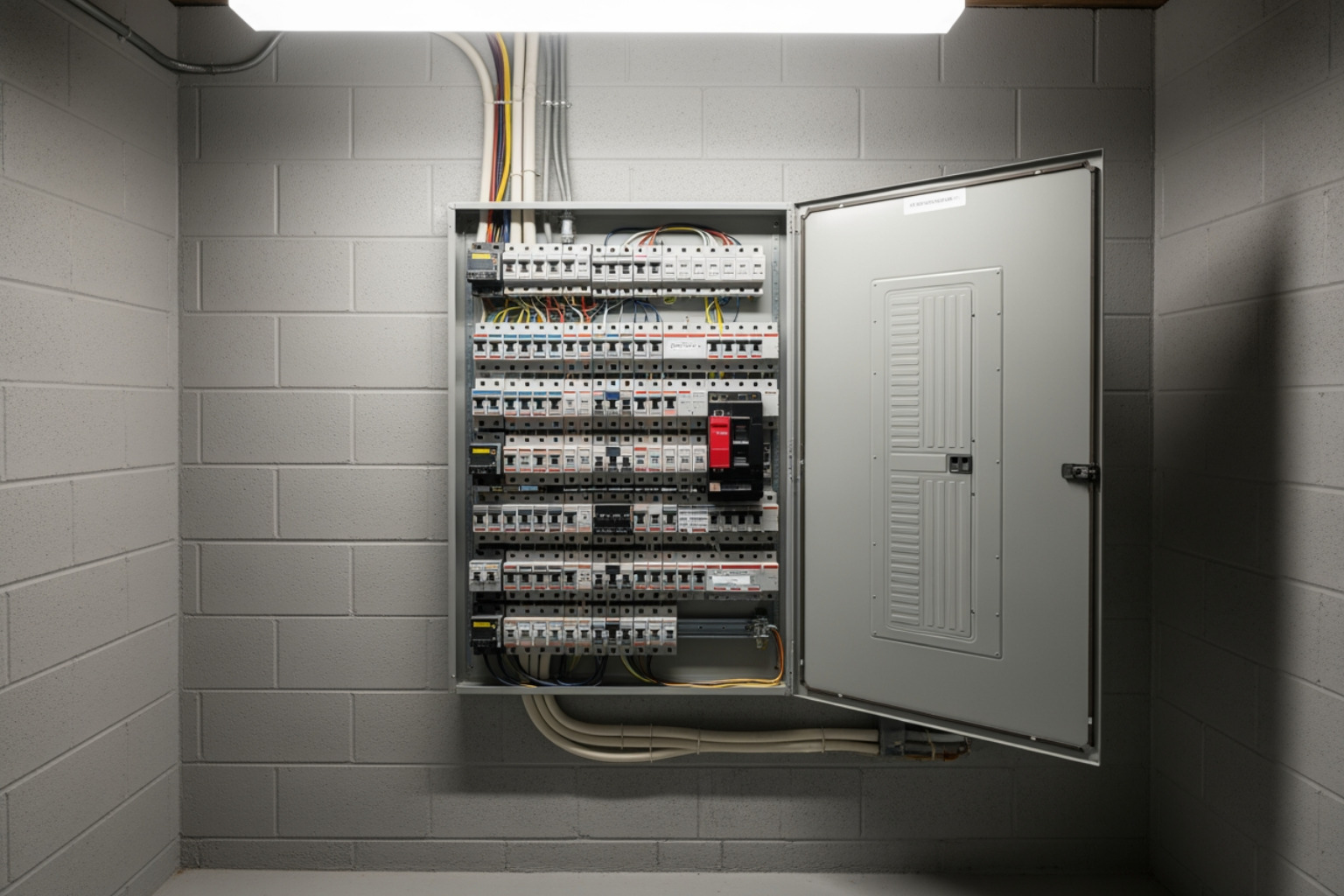

Can one closet circuit carry a lighted mirror, a garment steamer, and six cans of trim lighting at the same time? Usually not. A walk-in closet that becomes a dressing room stops being storage and starts being a room with real demands on it, from colour-accurate light to a receptacle where the steamer actually sits. One bare bulb tapped off the bedroom lighting circuit was never sized for any of that. Homeowners who ring round for electricians Flower Mound TX before the drywall opens are really choosing between two paths. Adding a dedicated circuit costs several hundred dollars more than splitting the one already there, and it is the option that still works once the room is in daily use.
The Closet Circuit Was Never Meant for This
Most closet lights sit at the tail end of a bedroom circuit that already feeds two bedside lamps, a television, and whatever charges overnight. That arrangement was honest when the closet held a single 60-watt bulb and a shoe rack. It stops being honest the moment a mirror, a steamer, and a small dehumidifier arrive, because the usual fix is a power strip and a cord run under the door. Those strips are not neutral hardware. Fox Business reported a March 2026 recall of power strips sold on Amazon that lacked supplementary overcurrent protection, pulled after two reports of sparking and melting. Never run a garment steamer, a space heater, or a hair dryer off a power strip or an extension cord, because they pull enough current to heat the cord itself, and they belong in a wall receptacle. What we find on most of these conversions is that the closet is where cords go to hide, so the load hides along with them.
Option One Splits the Bedroom Circuit
Splitting means tapping the circuit that is already there, adding a switch leg, and dropping in a receptacle or two without ever opening the panel. It is quick and cheap, and for some closets it is genuinely the right answer. If the room will only ever hold light and a phone charger, split the circuit and put the savings into better fixtures. Once anything in there heats, steams, or dries, a dedicated line wins. The limit is not really the wire, it is the breaker, which is already carrying a bedroom. If the closet light dims when the air conditioner starts up, stop adding load and have the circuit checked before anything else goes on it.
Option Two Runs a Dedicated Line
A dedicated line is a home run from the panel to the closet on its own breaker, sized for receptacles rather than for lights. Ask the electricians Flower Mound TX homeowners hire for panel work and the answer comes back consistent: the copper is not the expensive part, the access is. Call it a morning’s work. Honestly, closer to a full day once the panel has no spare space, the run crosses two joists, and the drywall patch has to dry before anyone paints. A bedroom circuit does not complain until it is already too late, which is the argument for sizing the wire for the room you are building instead of the closet you are leaving behind. Switching belongs in this conversation too, since a dressing room wants the overheads and the mirror on separate controls.
Doing the Math on Both Paths
Say the shared work on a six by eight walk-in in a Southlake master suite is identical either way: six trim fixtures at $95 each, so $570; a dimmer and switch leg at $150; a pair of receptacles at $170. That is $890 of work whichever path you pick. Splitting the bedroom circuit stops right there, and the room is finished for under a thousand dollars. The dedicated line adds a home run at $820, a breaker at $45, drywall patch and paint at $210, plus permit and inspection at $95, which brings it to $2,060. Swap the trim for fixtures rated above 90 on the colour rendering index at $70 more apiece and the dressing-room scope comes to $2,480 all in. Those figures are an illustrative scenario rather than a quote, but the shape holds: the dedicated path runs roughly double, and it is the half of the budget nobody has to revisit.
Light Quality Decides More Than Capacity
Capacity keeps the room safe, and light quality is what makes the room worth building. A mirror that renders skin and fabric badly sends you back to the bedroom window to check a jacket, which defeats the point of the project. Two fixtures carrying the same wattage and the same 3000K label can render a navy blazer differently, and that gap shows up on the colour rendering index rather than anywhere on the box. Dimming is the other half, because a driver that flickers at 20 percent is useless for makeup even though it passes every safety test it needs to. The pattern we run into again and again is a beautifully built closet lit by whatever the supply house had on the shelf that week.
The mirror is the fixture guests notice. Everything behind it is the circuit that lets it do its job.
Pay Once for the Circuit You Keep
This decision turns on how long you plan to use the room, not on how tidy the wiring diagram looks when it is drawn. A split circuit is the cheaper invoice and the likelier callback; a dedicated line is the larger invoice and the end of the conversation. Whether a permit and inspection are needed varies by city and by how much wiring gets touched, so ask the local building office before the drywall closes rather than after. Get the circuit right and the closet stops being a storage room with a bulb in it, which was the entire reason for tearing into it.
Read More at Celebrity Times




