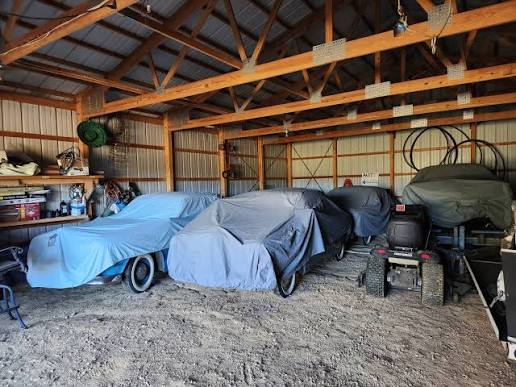

The car is never driven. The car is never rained on. The car never sits outside for so much as an afternoon. And the rocker panel below its driver’s door is blooming rust anyway. That was the puzzle at a fourteen-car private collection in a barrier-island garage on the North Carolina coast, insured near $2.3 million and climate-controlled since the day the slab was poured. By the end of that week the owner was typing condition assessment nc into a search bar, which is where most collectors end up once polishing stops fixing things.
The climate system was doing its job, to be fair. The room held 70 degrees and 45 percent relative humidity, logged hourly, and there were tidy graphs to prove it. What nobody had was a record of the metal itself. No photographs from a fixed angle, no coating thickness readings, no note of which seams looked slightly off in 2023 and look worse now. Control without measurement is not protection, it is just a comfortable room.
Climate Control Does Not Remove Chlorides
A barrier island puts salt aerosol into the air every day the wind blows onshore, and it arrives through door seals, on shoes, and on the tires of the one car that does get driven to breakfast on Sundays. Once chloride lands on a surface it stays there until somebody washes it off. Think of sugar left in an open bowl in a humid kitchen. Nothing spilled, nothing leaked, and by August the sugar has pulled enough water out of the air to clump on its own. Salt behaves the same way on a bumper, and it starts drawing moisture at humidity levels well below the point where anyone would describe the air as wet.
Climate control conditions the air in the room. It does nothing about the chloride already sitting on the chrome.
Example scenario: reading early indicators in a coastal collector garage (illustrative pairings, not measured data)
| What The Owner Notices | What It Usually Suggests | The Step That Confirms It |
| Fine orange bloom along a chrome bumper edge | Chloride deposits holding moisture at weak points in the plating | Surface salt sampling plus plating thickness readings |
| A dull haze returning days after a fresh coat of wax | A trapped moisture film, not a polishing defect | Humidity logged at floor level and mapped against the car’s position |
| Pitting on a welded seam under the rear valance | Localized attack beneath a coating breach | Non-destructive testing and documented photo references |
| Brown weeping at a fastener head | Crevice corrosion starting under the washer | Fastener removal, inspection and a dated baseline photo |
In practice, what turns up first on these inventories is almost never the car anyone worries about. The show-winning convertible gets washed, waxed and stared at constantly, so it gets caught early. The trouble starts on the car parked at the back that has not moved since 2019, usually at a fastener or at a seam where two different metals meet. I could spend a page on the signed jerseys and the plated trophies along the same wall, which are quietly doing a slower version of the same thing. Back to the cars, though, because the cars are where the insured value sits.
What The First Ninety Days Of Monitoring Show
Documentation has stopped meaning a folder of photographs. In a May 2026 piece on predictive corrosion control, an Inspenet analysis described real-time monitoring built on online sensors and thickness measurement probes feeding continuous data, with algorithms processing those readings to calculate how a corrosion rate is evolving and to predict remaining service life. That is written for pipelines and process plants, not garages. The logic scales down cleanly though, and it is the same logic behind a condition assessment NC collectors commission for a private fleet: measure, repeat, compare.
The first week is mostly inventory and photography, one car at a time, from fixed reference points so the next round can be compared rather than admired. By the end of the first month you have the boring and genuinely useful part, which is coating measurements, humidity logged down at floor level where it is always worse than at the thermostat, and a short list of the five or six spots that are actually moving. By day 90 the second round of readings lands, and that is the first moment anyone can state a rate instead of an impression. Ninety days will not tell you what the collection looks like in 2036. It will tell you which three panels are changing fastest, and that is the question deciding where money goes this year.
Document Condition Before The Damage Compounds
Corrosion compounds, and that is the part collectors underestimate. A chloride film that costs an afternoon and a jug of distilled water this spring turns into a pit, then a perforation, then a panel somebody has to fabricate by hand at a rate that reflects how few people still can. Salt does not take the winter off. A report is worth having even when everything comes back clean, because a documented baseline is what makes the next inspection mean something, and it is what an insurer or an eventual buyer will ask to see. Get the condition on paper while the honest answer is still cosmetic.
Read More at Celebrity Times